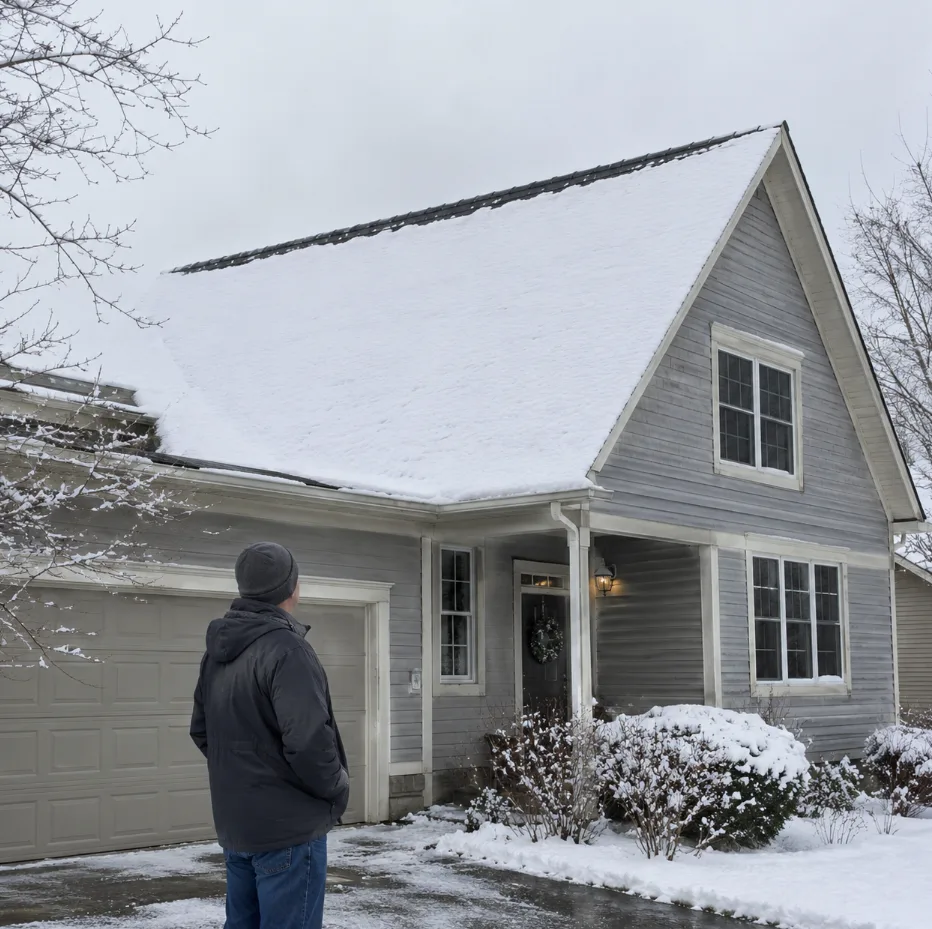
The best roof pitch for snow falls between 6/12 and 12/12, or 26.6° to 45°, in regions with regular heavy snowfall. For asphalt shingles, 4/12 works as a practical minimum in snow country, and real snow-shedding benefits start only above 7/12. Metal roofing sheds snow at far lower slopes, and 3/12 to 6/12 serves most snowy climates as long as the area below the eaves stays clear.
Pitch never works alone. The roofing material decides when snow starts to slide, and the building code gives a steeper roof credit for a lighter snow load only when the surface lets snow go. A 6/12 shingle roof and a 6/12 metal roof behave very differently in the same storm.
Best Roof Pitch for Snow by Roofing Material
Asphalt shingles and metal panels sit at opposite ends of the snow range. Shingles hold snow in place because of their gritty granule surface, while smooth metal lets it slide. ASCE 7, the standard engineers use to set roof snow loads, treats asphalt shingles, wood shingles, and shakes as non-slippery surfaces and metal as slippery. Our overview of roof types shows how these materials compare beyond snow.
Asphalt Shingles
For a shingle roof in a snowy region, the best pitch runs from 7/12 to 12/12. Below about 30°, or a 7/12 pitch, snow on shingles rarely slides, so the roof carries the full design snow load. A 6/12 shingle roof therefore performs like a flat roof for structural purposes, even though it drains meltwater well.
The building code allows asphalt shingles down to 2/12. Between 2/12 and 4/12, it requires a double layer of underlayment because slow-draining meltwater can back up under the shingles. In areas with heavy winters, most roofers treat 4/12 as the lowest pitch worth shingling.
Metal Roofing
Metal roofing gives the widest choice of pitch in snow. Snow can slide on smooth metal at slopes under 1/12, and a 3/12 to 6/12 metal roof clears itself after most storms. Code minimums depend on the panel type: 1/4:12 for standing seam, 1/2:12 for lapped panels with sealant, and 3/12 for lapped panels without it.
The trade-off shows up at the eaves. Snow leaves a metal roof in large sheets, so any pitch above a walkway, driveway, deck or lower roof needs snow guards.
Roof Pitch Chart for Snow
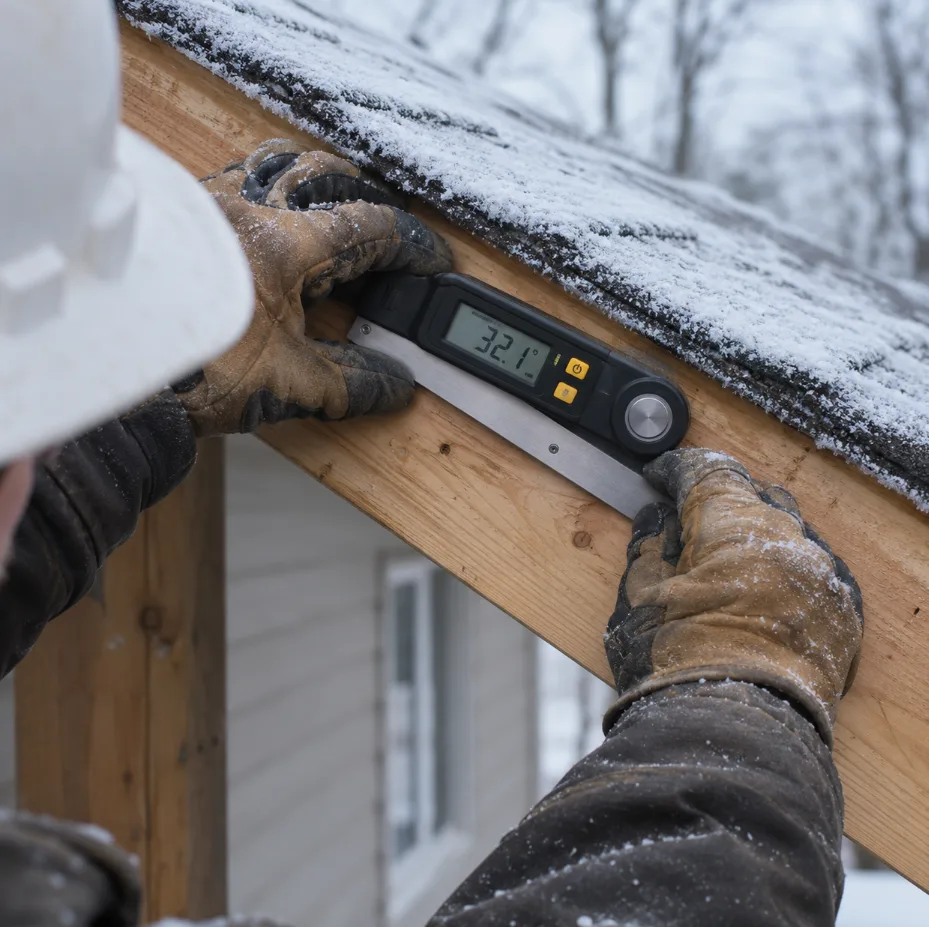
Roof pitch shows how many inches the roof rises for every 12 inches of horizontal run. The chart below converts common pitches to degrees and shows the share of the flat-roof snow load that ASCE 7 assigns to a heated house at each slope.
| Pitch | Angle | Design snow load, shingles | Design snow load, metal | How snow behaves |
|---|---|---|---|---|
| 2/12 | 9.5° | 100% | 93% | Sits and melts in place |
| 3/12 | 14.0° | 100% | 86% | Slides on metal only |
| 4/12 | 18.4° | 100% | 79% | Practical minimum for shingles |
| 5/12 | 22.6° | 100% | 73% | Rare slides on shingles |
| 6/12 | 26.6° | 100% | 67% | Common choice in snow regions |
| 8/12 | 33.7° | 91% | 56% | Slides off shingles regularly |
| 10/12 | 39.8° | 75% | 46% | Frequent sliding on any surface |
| 12/12 | 45.0° | 62% | 38% | Sheds after almost every storm |
The metal column applies only to an unobstructed roof with enough space below the eaves for the snow to land. Snow guards, chimneys or a lower roof in the slide path cancel that reduction, and an engineer then designs the roof like the shingle column.
A 5/12 pitch handles light to moderate snow well with either material. A 3/12 pitch suits snowy areas only with metal, or with double underlayment and a full ice barrier under shingles. A roof slope of 22.5 degrees corresponds to a 5/12 pitch.
How Roof Pitch Changes Snow Load
Roof snow load starts with the ground snow load for your location, which the local building department publishes in pounds per square foot (psf). For a typical heated house, ASCE 7 multiplies the ground value by 0.7 to get the flat-roof load, then by a slope factor that shrinks as the roof gets steeper.
On a warm roof with shingles, the slope factor stays at 1.0 up to 30° and then drops in a straight line to zero at 70°. On a slippery, unobstructed warm roof such as metal, the drop starts at about 5°.
Take a house with a ground snow load of 30 psf, which gives a flat-roof load of 21 psf. A 6/12 shingle roof on that house is designed for the full 21 psf. The same pitch in unobstructed metal drops to about 14 psf, and a 12/12 shingle roof comes to about 13 psf.
Actual snow weight depends on how wet the snow is. FEMA puts one foot of fresh snow at 3 psf for light, dry powder and 21 psf for wet, heavy snow. One inch of ice adds a little under 5 psf. A quick estimate multiplies snow depth in inches by 1.25 and adds 5.2 psf for each inch of ice. Most residential roofs in good condition carry at least 20 psf.
At What Pitch Does Snow Slide Off a Roof
Snow slides off asphalt shingles mostly above 30°, or 7/12, and very readily at 45°, or 12/12. Between 22° and 30°, a slide can happen but is unlikely, and below 22°, or about 5/12, snow on shingles generally stays put. On metal, slate, synthetic shakes, and smooth membranes, snow can slide at pitches under 1/12.
Sliding snow brings its own risks. A sheet of wet snow coming off a steep roof can tear off gutters, crush shrubs, block a door, and land on a person or a car. When it drops onto a lower roof, that lower roof takes an extra load that engineers calculate separately.
Snow guards hold snow on the roof until it melts. On shingle roofs, they are usually unnecessary below 5/12 and worth considering above 7/12 in moderate and heavy snow areas. On metal roofs, guards belong above any walkway, driveway, deck or entrance regardless of pitch.
Best Roof Pitch for Snow by Climate
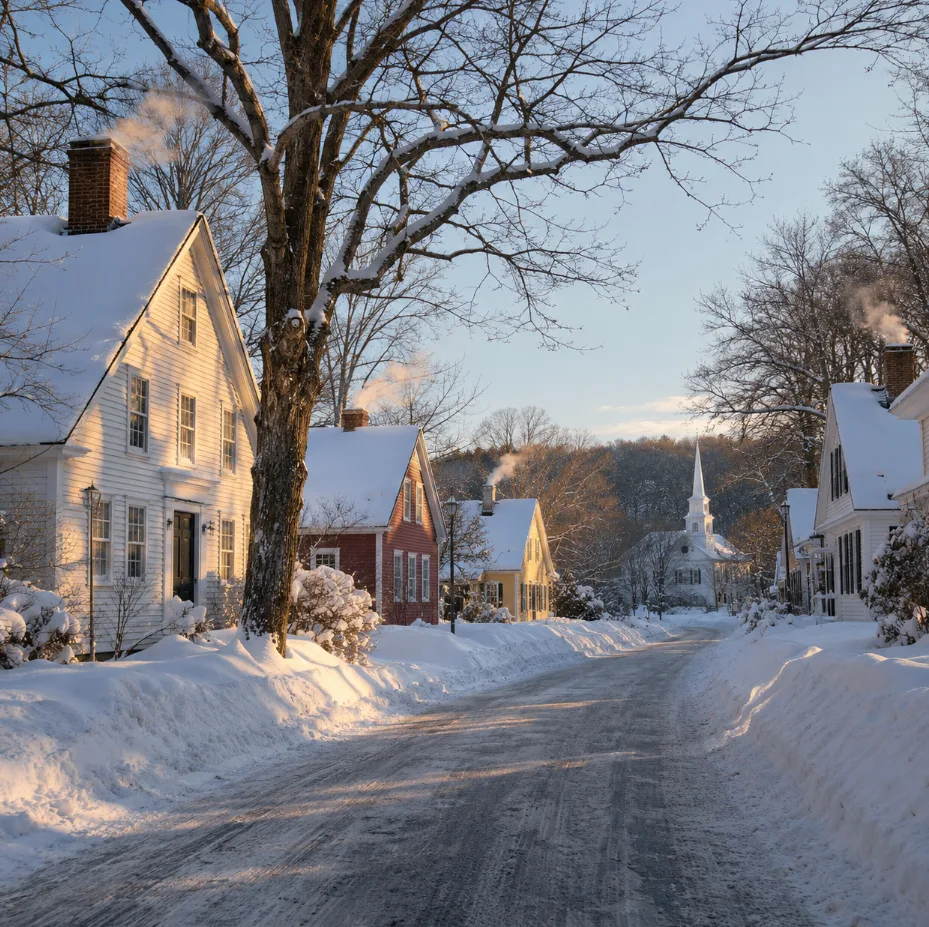
The right pitch for a house depends first on how much snow its roof must carry. Residential roof design loads range from about 10 to 20 psf in the Mid-Atlantic states to 40 to 70 psf in New England.
| Roof design snow load | Shingle roof pitch | Metal roof pitch |
|---|---|---|
| Up to 20 psf (Mid-Atlantic) | 4/12 to 6/12 | 3/12 to 6/12 |
| 20 to 40 psf (moderate snow) | 6/12 to 8/12 | 4/12 to 8/12 |
| Over 40 psf (New England, heavy snow areas) | 8/12 to 12/12 | 6/12 to 12/12 with snow guards |
Simple gable and hip roofs carry snow most evenly at any of these pitches. Valleys, dormers, and walls rising above a roof collect drifts, which concentrate extra weight on small areas.
On an existing house, the pitch is set by the framing, and changing it means rebuilding the roof structure. During a roof replacement, the useful decisions are the material and the underlayment. In areas where ice dams form, the code requires an ice barrier from the eave edge to at least 24 inches inside the exterior wall line. A shingle roof between 2/12 and 4/12 also needs double underlayment.
Frequently Asked Questions
Is a 5/12 roof pitch OK for snow?
Yes. A 5/12 pitch, or 22.6°, works for light and moderate snow with shingles and handles heavier snow with metal. Where roof design loads exceed 40 psf, a steeper pitch or a metal roof gives a better safety margin.
Is a 3/12 roof pitch suitable for snow?
It works with metal roofing, which lets snow slide at that slope. With asphalt shingles, a 3/12 roof needs double underlayment and an ice barrier, and it holds snow and meltwater longer, so it suits only areas with light snow.
What is the snow load on a 4/12 roof pitch?
A 4/12 roof, or 18.4°, with shingles is designed for the full flat-roof snow load of its location. With unobstructed metal, the design load drops to about 79% of that value. The exact number in psf comes from your local ground snow load.
Can a roof handle 20 inches of snow?
Usually, yes. Twenty inches of average snow weighs about 25 psf, while the same depth of wet, heavy snow can reach 35 psf. Most roofs in good condition carry at least 20 psf and roofs in snowy areas are built for more, so ice layers and drifts pose the bigger risk.
What roof slope is 22.5 degrees?
A slope of 22.5 degrees matches a 5/12 roof pitch, which rises 5 inches for every 12 inches of horizontal run. The exact angle of a 5/12 pitch works out to 22.6°.
Does a steeper roof prevent ice dams?
A steeper pitch drains meltwater faster, but it cannot stop ice dams on its own. They form when attic heat melts snow that then refreezes at the cold eaves, so air sealing, attic insulation and ventilation do most of the work. Our guide to the impact of weather on your roof covers winter preparation in more detail.
Choosing the Best Roof Pitch for Snow
For snowy regions, the best roof pitch is 6/12 to 12/12, and the roofing material decides where in that range a roof should sit. Shingle roofs start shedding snow and earning a lower design load only above 7/12. Metal roofs shed snow from about 3/12 and need snow guards wherever falling snow could hit someone.
Before replacing a roof in snow country, have a roofer check the framing, attic insulation and eave details along with the pitch. All of them affect how the roof handles winter. Paramount’s crews handle full roof replacement across Greater Philadelphia.

Comments