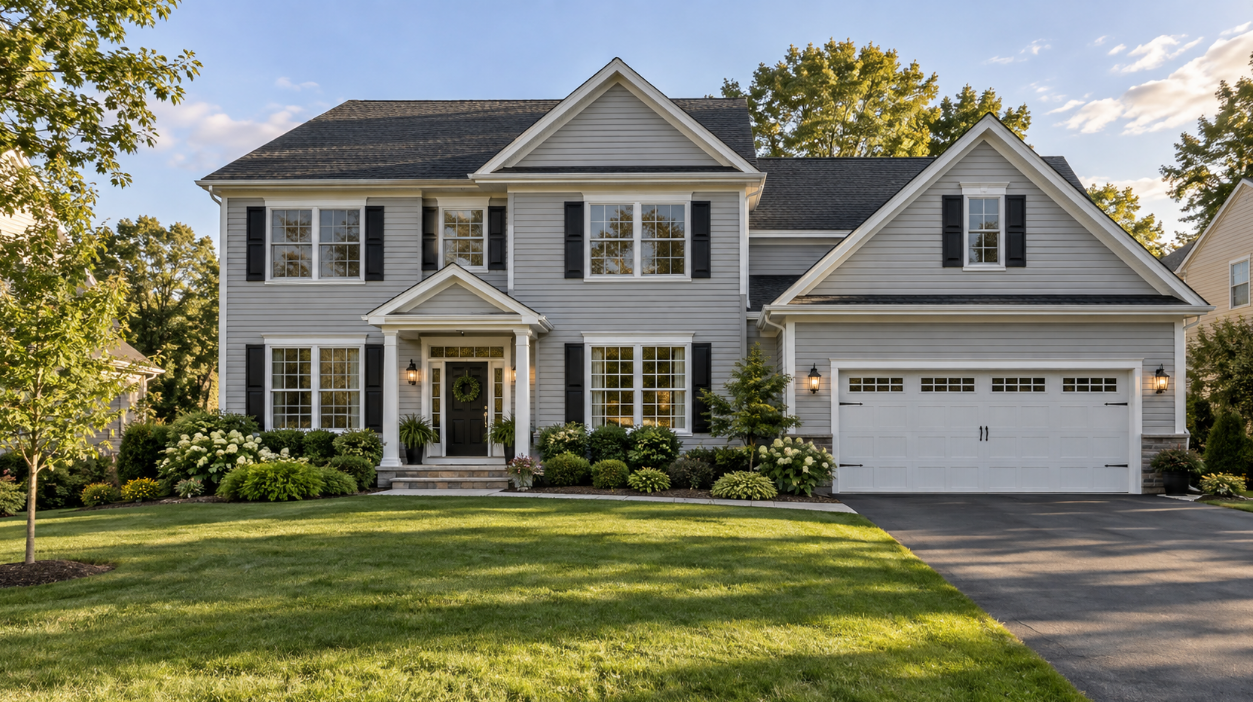
House siding colors group into six families: whites and creams, grays, beiges and sand tones, blues, greens, and deep saturated darks. Grays and soft neutrals have led sales for a decade, though blues and greens are gaining on traditional homes. The choice comes down to three things you cannot change easily: the roof, the brick or stone already on the house, and the architectural style.
Popular Vinyl Siding Colors by Family
Most siding colors for house exteriors fall into these six families, and every manufacturer covers all of them under different names. The same warm gray may be Pebble Clay at one brand and Granite at another, which is why comparing physical samples matters more than comparing color charts. Green vinyl siding colors show the widest spread of any family, running from pale sage through olive to deep forest. They also read very differently depending on how much light a wall receives.
Color family | Typical shade names | Suits these homes | Pairs with |
White and cream | Oyster White, Linen, Antique Ivory | Colonial, farmhouse, Cape Cod | Black shutters, dark roofs, natural stone |
Gray | Granite, Pewter, Silver Ash, Slate | Almost any style, new construction | White trim, charcoal roofs, black windows |
Beige and sand | Sandstone, Wheat, Desert Tan, Pebble Clay | Ranch, split-level, traditional suburban | Brown roofs, warm brick, wood-tone doors |
Blue | Harbor Blue, Coastal Sage Blue, Midnight Blue | Colonial, coastal, Victorian | White trim, gray roofs, stone foundations |
Green | Sage, Cypress, Forest, Olive | Farmhouse, craftsman, wooded lots | Cream trim, brown or weathered-wood roofs |
Deep and saturated | Espresso, Charcoal, Autumn Red, French Roast | Modern farmhouse, craftsman, accent walls | Light trim, board-and-batten accents |
Panel profile changes how a color reads. The same shade appears darker in a dutch lap than in a flat panel, and darker again on shake or scallop. Deeper shadow lines fall across those surfaces. The profiles themselves are covered in the guide to siding types.
How to Choose Siding Colors for Your House
Color selection goes faster when you work from fixed to flexible. Three filters remove most of the palette before you ever open a color chart.
Start With What You Cannot Change
The roof, any brick or stone on the front, the driveway, and the foundation are staying. All of them carry undertones, and siding that fights those undertones looks wrong even when the color is attractive on its own. Siding colors for houses with red brick, for example, work best in warm creams, soft greens, and muted browns. Cool grays placed next to red brick tend to look purple in afternoon light. Hold the samples against the brick outdoors before you decide anything else.
Match the Color to the House Style
Architectural style narrows the field further. Colonials in Pennsylvania and New Jersey carry white, cream, soft blue, and colonial red well, usually with contrasting shutters. Ranch homes suit earth tones and mid-tone grays that emphasize their horizontal lines. Craftsman houses look right in greens, browns and deeper neutrals with heavy trim. Modern farmhouses rely on white or very dark siding with black windows. A color that ignores the style reads as a remodel rather than as the house itself.
Neighborhood and HOA Rules
Many developments limit exterior colors to an approved list, and some townships regulate them in historic districts. Check those rules before ordering samples rather than after. Beyond the formal rules, walk the street. Your house should relate to its neighbors without repeating the house next door, and a shade already used on four homes within sight will make yours look like a copy.
Matching Siding Color to Your Roof
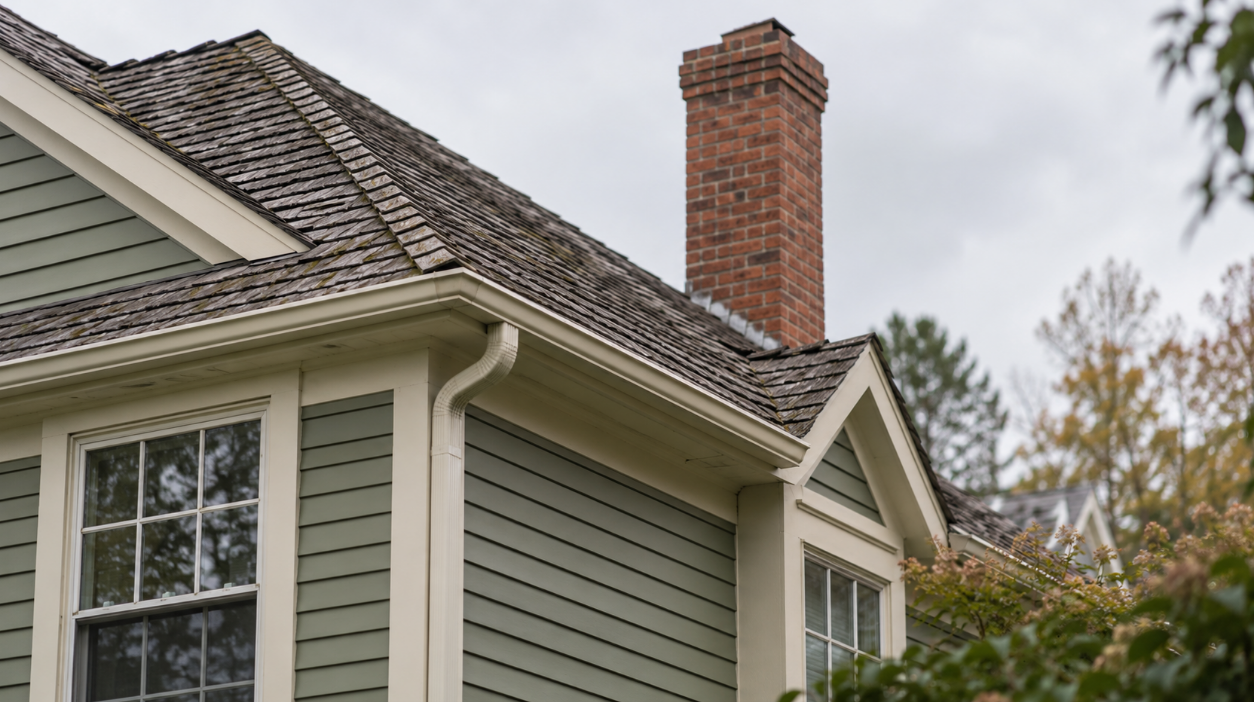
The roof covers more visible surface than any single wall and lasts 20 to 30 years, so it leads the pairing. Siding gets chosen around it, not the other way around.
Charcoal and black roofs are the most flexible partners. They sit under grays, whites, blues and greens without complaint, which is one reason they dominate new construction. Brown and weathered-wood roofs pull the palette warm, toward beige, cream, sage, and browns, and they clash with cool blue-grays. Weathered-wood shingles, common across the Mid-Atlantic, carry a mix of brown and gray. That combination accommodates both warm and cool neutrals, making them the safest roof to build a palette around. Green and red roofs on older homes restrict the field sharply: greens want cream or tan siding; reds want cream, soft gray or white.
Undertone matters more than the color name. A warm gray roof under a cool gray wall produces a muddy result that photographs poorly and looks worse in person. If you are replacing both surfaces, choose the roof first, then bring its sample to the siding selection. The relationship also affects resale, as the analysis of what roof color increases home value in the Mid-Atlantic shows.
Light vs Dark Vinyl Siding Colors
Darker panels have moved from rare to common in the last ten years, and they behave differently from light colors in ways worth understanding before ordering.
How Dark Colors Behave in the Sun
Dark surfaces absorb more solar heat, and vinyl expands as it warms. Standard vinyl formulations can distort or warp in deep colors. Manufacturers therefore produce dark shades with heat-stable pigments and reinforced formulations, often at a price premium. Installation tolerances matter more too, since panels need room to expand along their fastening slots. South and west walls, and walls facing reflective surfaces such as low-e windows on a neighboring house, see the highest surface temperatures.
Fading and Color Retention
All exterior color fades under ultraviolet light, and darker and more saturated shades show the change earlier because the loss is more visible against the original. Current premium lines use fade-resistant pigment technology and carry warranty language specific to color retention, so read what that warranty covers and for how long. Fading also happens unevenly, which becomes a problem years later when a damaged panel is replaced and the new one no longer matches.
Which Colors Hide Dirt and Pollen
Mid-tone neutrals hide the most. Pollen coats everything in this region each spring, and it shows clearly on dark blues, greens, and charcoals. Roof runoff and dirt streaks show most on white and cream. Sand, taupe, and mid grays sit between the two problems and need washing least often.
Trim, Shutters, and Accent Colors
A practical exterior uses three colors. The field color covers the walls, the trim color outlines the windows, corners, soffit, and fascia, and the accent color appears on the front door and shutters. White trim against any field color is the safest combination and the most common. Reversing the contrast, with dark trim against light siding, produces a sharper, more contemporary look. It also emphasizes window proportions, so it works best when the windows are well placed.
Accents carry the personality. A red, navy or deep green door against gray or white siding changes the whole front of the house for the cost of a can of paint. Mixing textures is the other option available in vinyl. Shake panels in the gables or board and batten on a front-facing bay, in a shade one or two steps from the field color, add depth without introducing a fourth color. Keep the shift subtle, since a strong jump between field and accent panels makes the wall look patched.
How to Test a Color Before You Order
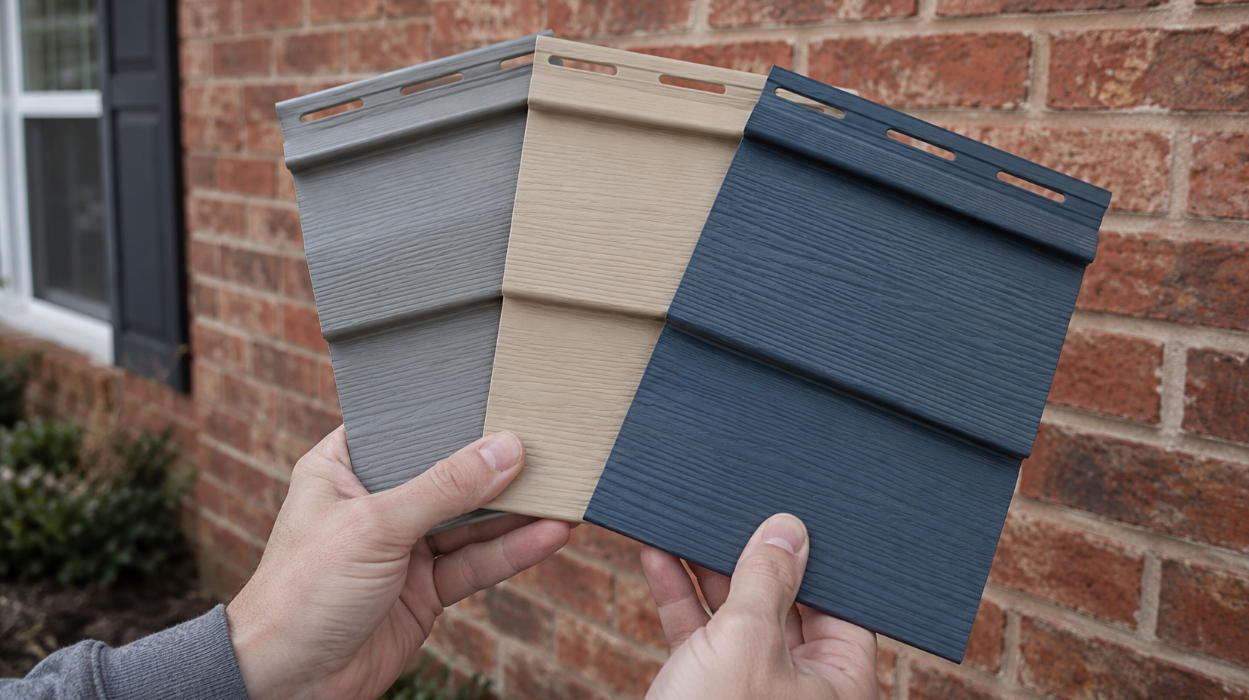
Color chips lie. A two-inch chip under fluorescent light in a showroom has almost nothing in common with 1,800 square feet of the same color under an overcast Pennsylvania sky. Work through these steps before you commit:
- Order full-size panel samples rather than chips.
- Hold each sample against the roof, brick, stone and driveway outdoors.
- Look at it in morning light, at midday and at dusk.
- Check it on both a sunny wall and a shaded wall.
- Photograph the samples in place and review the photos on a screen.
- Run your house through a manufacturer’s visualizer tool to see full elevations.
- Drive through nearby neighborhoods and look at finished houses in the shade you are considering.
To see vinyl siding colors on houses, pictures of completed jobs outperform any color chart. They present the shade at full scale with real trim, roof, and landscaping around it. Our project gallery shows homes in the Greater Philadelphia area in a range of shades. Expect the full wall to read one step lighter and one step more saturated than the sample in your hand. Homeowners who choose from chips alone regularly find the finished result brighter than they expected.
Frequently Asked Questions
Short answers to the questions homeowners ask most often when choosing a color.
What is the most popular vinyl siding color?
Gray has led for roughly a decade, with white, beige and sand close behind. Within gray, mid-tone warm grays sell best because they work with the widest range of roofs and brick. Blues and greens have grown steadily on traditional and farmhouse styles.
Do dark vinyl siding colors fade faster?
Dark and saturated shades show fading sooner, though the panel does not necessarily fade faster. Premium lines use heat-stable and fade-resistant pigments, and their warranties spell out what color change is covered. Ask for that warranty language in writing before choosing a deep shade.
Does siding color affect home value?
Color influences how quickly a house sells more than what it sells for. Neutral siding colors for homes in established neighborhoods appeal to the widest pool of buyers, while unusual colors narrow that pool. Condition matters far more than shade.
Can vinyl siding be painted a different color?
Vinyl can be painted with acrylic paint formulated for it, but only in a shade equal to or lighter than the original. Darker paint makes the panel absorb more heat than it was designed for and can cause warping. Painting also usually voids the manufacturer’s warranty.
What siding color makes a house look bigger?
Light, low-contrast combinations make a house read larger, especially when the trim is close to the field color. Dark siding makes a house appear smaller and more grounded. Horizontal lap profiles stretch a facade visually, while vertical board and batten raises it.
Why does the color look different on the whole house?
Scale and light change the perception. A large area reflects more light back at you, which makes the color read lighter and more intense than the sample. Sun exposure shifts it again through the day. Always judge a shade from a full-size sample outdoors.
Before You Order
Start with the roof and any brick or stone, since they set the undertone for everything else. Narrow to three candidates, order full-size samples and look at them on your own walls at several times of day. Confirm your HOA or township rules in the same week, and check the color-retention warranty on any dark shade. Once the color is settled, the siding replacement process is straightforward, and the decision you spent time on is the part you will see every day.

Comments