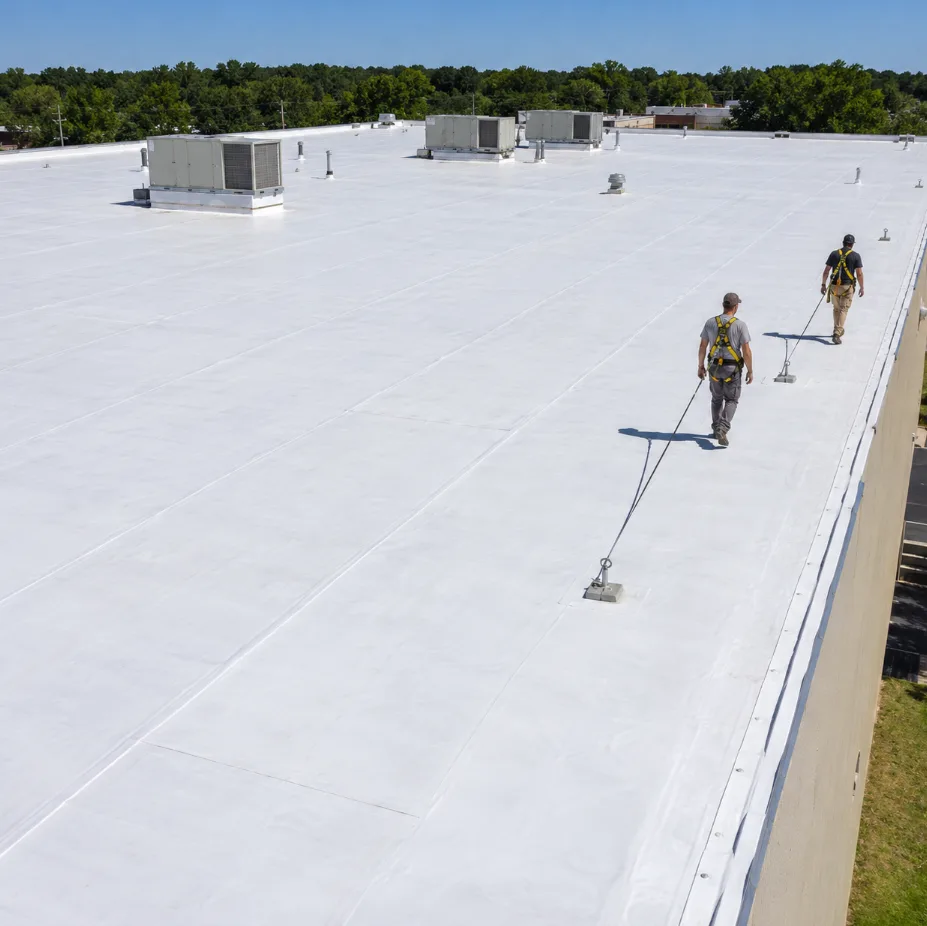
TPO roofing is a single-ply membrane made from thermoplastic polyolefin and used to waterproof flat and low-slope roofs. Installers unroll the sheets across the deck, secure them with fasteners or adhesive, and weld the overlapping edges with hot air. Once welded, the separate sheets function as one continuous waterproof surface.
The first TPO-type roof in the U.S. went down around 1987, and the material took hold in commercial roofing during the 1990s. Today it leads the single-ply market on new low-slope roofs. It appears on warehouses, retail buildings, and offices, and also on porches, additions, and flat sections of residential roofs. Our overview of commercial roof types shows where it sits among the other options.
What TPO Roofing Is Made Of
A TPO membrane blends polypropylene with ethylene-propylene rubber. The plastic gives the sheet strength and lets it melt and fuse at the seams, while the rubber keeps it flexible. Unlike PVC, TPO stays flexible without added plasticizers, so nothing can leach out of the sheet and leave it brittle with age.
Each sheet has three layers: a weather-facing top ply, a polyester scrim in the middle for tear strength, and a bottom ply. Membranes sold in the U.S. are tested to ASTM D6878, the standard that sets minimum values for breaking strength, heat aging and weather resistance.
Manufacturers produce two backing options. Smooth-back sheets are the usual choice for fastened and glued roofs. Fleece-back sheets carry a layer of polyester felt on the underside, which adds impact resistance and helps the membrane bond to rough surfaces.
White remains the most popular color because it offers the highest solar reflectivity. Tan and gray are widely available, and some manufacturers offer black or custom colors for roofs that people can see from the street. Sheets come in rolls up to 12 feet wide and 100 feet long, so a typical roof needs fewer seams than it would with narrower materials.
TPO Membrane Thickness and Lifespan
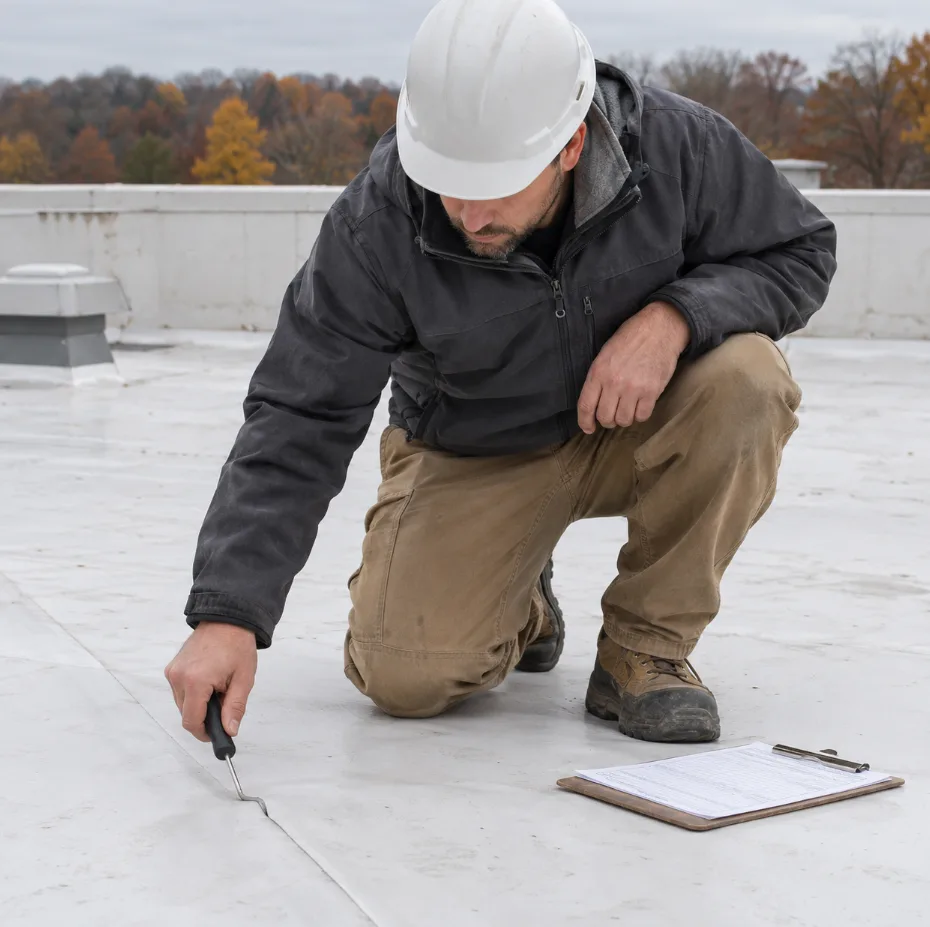
TPO comes in three standard thicknesses: 45, 60 and 80 mil, where one mil equals a thousandth of an inch. A well-installed TPO roof usually lasts 15 to 30 years, and thickness has the biggest say in where a roof lands within that range.
| Thickness | Common use | Longest guarantee (GAF EverGuard) | Installed cost per sq ft |
|---|---|---|---|
| 45 mil | Budget projects, light foot traffic | 20 years | $5.00–$8.00 |
| 60 mil | Standard choice for most roofs | 25 years | $6.50–$10.50 |
| 80 mil | Long ownership, hail, heavy traffic | 30 years | $8.50–$12.00 |
Thickness matters because the protective layer above the scrim is thin. In a 45-mil sheet it measures 15 to 19 mil, and in a 60-mil sheet it measures 21 to 27 mil. Ultraviolet exposure and weathering gradually erode this top layer. Once the scrim starts to show through, the membrane is close to the end of its service life.
Cold climates provide another reason to specify 60 mil. GAF tested membranes that had spent 12 years or more on real roofs. Every 60-mil sample still met the cold-flexibility requirement, while the 45-mil samples cracked at -40°F.
Maintenance decides whether a roof reaches its rated life. Inspect a TPO roof at least once a year and after every severe storm, and look hardest at seams and flashings. Keep drains and scuppers clear so water cannot pond, and remove leaves and debris. Wash the surface when dirt builds up, since a dirty white roof loses much of its reflectivity.
How a TPO Roof Is Installed
A TPO roof goes down in layers. On top of the roof deck, the crew lays a vapor barrier where the building needs one, then polyiso insulation boards, then a cover board, and finally the membrane. Neighboring sheets overlap by a few inches, and a hot-air welder fuses each overlap into a seam. EPDM, the main rubber alternative, joins its seams with tape and primer, and that difference shows up years later in how well the seams hold.
Building codes require a slope of at least 1/4 inch per foot under a TPO roof so water runs toward gutters, scuppers or drains. Contractors attach the membrane itself using one of three primary methods.
Mechanically Attached
Screws and large plates hold the edge of each sheet to the deck, and the next sheet overlaps the fasteners before the seam is welded. This is the most common attachment method and typically the least expensive. Because no adhesive goes down across the roof, crews can install it in a wider range of temperatures.
Fully Adhered
The membrane is glued to the cover board across its entire surface. Adhered systems cost more, but they lie smoother, flutter less in high wind, and look cleaner where the roof is visible.
Induction Welded
Plates are screwed to the deck first and the membrane is rolled over them. An induction tool then heats each plate from above until its coating bonds to the underside of the sheet. No fastener ever pierces the membrane, and wind loads spread more evenly across the roof.
A fourth method, ballasting, holds a loose-laid membrane down with river stone or pavers. It requires a structure engineered to carry the additional weight, so contractors specify it less often today. TPO can also go over an existing roof if the old system is dry and sound, which saves the cost of tearing it off.
TPO Roofing Pros and Cons
TPO earns its market share on price and energy performance. Its weak points come from a shorter history than older membranes and from how much the result depends on the crew.
Advantages
- White surface that meets ENERGY STAR requirements
- Welded seams stronger than taped seams
- Lower installed cost than PVC
- Resistance to UV, mold growth and punctures
- No plasticizers to dry out over time
- Light weight with no ballast needed
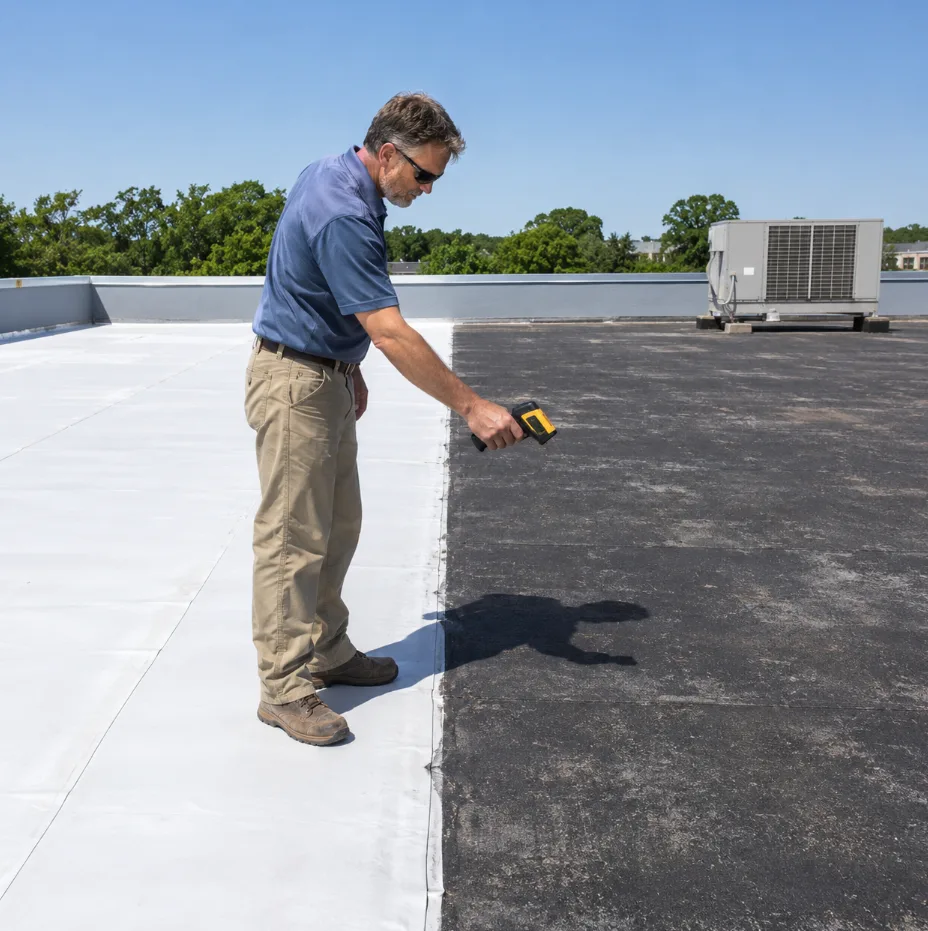
A new white TPO sheet reflects roughly three-quarters of the sunlight that hits it. That keeps the roof surface far cooler in July than a dark roof, and the rooms below need less air conditioning as a result.
Disadvantages
- Shorter track record than EPDM or PVC
- Formulas differ between manufacturers
- 45-mil sheets lose cold flexibility with age
- Cannot be painted
- Seam quality depends on the welder
- Punctures from foot traffic and dropped tools
Installation quality outweighs every other point on this list. A premium 80-mil membrane welded badly will fail sooner than a standard 60-mil membrane installed by an experienced crew certified by the manufacturer.
How Much Does TPO Roofing Cost
TPO roofing costs $4.50 to $14 per square foot installed in the U.S., and the material accounts for $1.50 to $3.50 of that. A 1,500-square-foot flat roof comes to roughly $6,800 to $21,000. Most residential projects average between $5.50 and $8.75 per square foot, depending on membrane thickness and roof complexity.
Membrane thickness, tear-off, and insulation determine the final price. Removing an old roof adds $1 to $2 per square foot, and new insulation adds $0.50 to $3. Fully adhered and induction-welded systems cost more than mechanically attached ones. For a price on your own building, see our TPO roofing service.
TPO vs EPDM vs PVC
TPO, EPDM and PVC cover most flat roofs in North America, and all three install as a single sheet layer. They differ in how the seams are joined, how much solar energy they reflect and how they resist grease and chemicals.
| TPO | EPDM | PVC | |
|---|---|---|---|
| Material | Thermoplastic polyolefin | Synthetic rubber | Polyvinyl chloride |
| Seams | Heat-welded | Taped or glued | Heat-welded |
| Standard color | White | Black | White |
| Grease and chemical resistance | Moderate | Low | High |
| Typical lifespan | 15–30 years | About 30 years | 25–30+ years |
| Installed cost per sq ft | $4.50–$14 | $4.25–$12 | $5–$15 |
Each membrane fits a different type of building. EPDM suits limited budgets and buildings where summer cooling is a minor expense. PVC belongs on restaurants and manufacturing facilities that exhaust grease or oils onto the roof. TPO covers the large middle ground of offices, warehouses, stores, and residential flat roofs where cooling costs matter and the budget sits between the other two.
Frequently Asked Questions
What is another name for TPO roofing?
It also goes by thermoplastic polyolefin roofing, TPO membrane or single-ply roofing. Many homeowners call it a rubber roof, although TPO belongs to the thermoplastics and the true rubber membrane on the market is EPDM.
Can TPO roofing be installed on a house?
Yes. TPO works on low-slope parts of a house, such as porch roofs, dormers, additions and rowhome roofs, as long as the slope is at least 1/4 inch per foot. Steeper residential roofs typically receive asphalt shingles or metal panels.
Is TPO cheaper than shingles?
Per square foot the two cost about the same: asphalt shingles run roughly $3.44 to $12 installed, and TPO runs $4.50 to $14. The two materials are not interchangeable, though. Shingles need a slope of at least 2 inches per foot, while TPO is made for roofs flatter than that.
Can you walk on a TPO roof?
Yes, TPO tolerates regular foot traffic during inspections and maintenance. Walkway pads welded along regular service routes protect the membrane where technicians walk most often, such as the path to rooftop HVAC units.
Can a TPO roof be painted?
No. Manufacturers advise against painting TPO, because ordinary paint does not bond to the membrane. Repairs and coatings should use only products designed for TPO, applied by a professional roofing contractor.
Does hail damage a TPO roof?
Large hail can puncture or crack TPO, especially thin sheets laid over soft insulation. Thicker membranes, fleece-back sheets and a rigid cover board all raise hail resistance. Some manufacturers offer guarantee coverage on qualified systems for hail up to 4 inches across.
Is TPO Roofing Right for Your Roof
TPO suits flat and low-slope roofs with a slope of at least 1/4 inch per foot, large open areas and summers that raise air-conditioning costs. On a roof like that, a 60-mil membrane with welded seams gives you a white, reflective surface for 20 years or more at a mid-range price.
Other membranes make more sense in a few cases. A restaurant venting kitchen grease onto the roof is better served by PVC, and EPDM fits a roof where the lowest upfront price outweighs reflectivity. Before choosing, have a roofer check the deck, the slope and the drains, because those three things decide how long any membrane lasts. Paramount’s crews inspect flat roofs across Greater Philadelphia and handle full commercial roof replacement.

Comments